React Native & AI Engineering Case Study · Mobile product engineering

Tare: Turning Habit Reflections into Meaningful Progress.

A mobile product where users keep control of their words—and the AI's interpretation.

Most habit apps start with a simple question: Did you do it today? But the story behind a habit is often more complicated. Someone might complete a goal despite a difficult day. They might avoid an unwanted behavior, feel proud of a small change, or notice a recurring obstacle. Tare is a mobile habit reflection product designed to capture that context. Users can record reflections in their own words, review AI-proposed information, and build a structured history over time.

Habit Reflection and Reviewable Check-ins

Product engineering

Listed on Google Play for Android

View Tare on Google Play

Save the original.
Review the interpretation.

Role
Shashank Sangule · Founder & Lead Developer, DivWeavers
Product
Mobile habit reflection · Reviewable AI-assisted check-ins
Platform
iOS and Android app architecture
Focus
Habit reflection, structured check-ins, history-based insights
Stack
React Native · Expo · TypeScript · Supabase · PostgreSQL · Edge Functions · pgvector · OpenRouter · RevenueCat · Expo Notifications

Case study at a glance

Product problem
Free-form habit reflections carry context that a completion mark alone cannot retain; progress views need consistent, reviewable fields.
Role and scope
Shashank Sangule, Founder & Lead Developer at DivWeavers: React Native app, Supabase backend, structured extraction, data rules, history, scheduled analysis, and mobile build setup.
Implemented solution
Save the original input before AI extraction, propose structured fields for user correction, then update the reviewed record. The review screen and architecture demonstrate durable input, typed validation, and backend safeguards.
Evidence limits
Extraction can fail; the original entry remains available for retry or Finish Later. Tare is listed on Google Play for Android. This does not establish runtime integration health, device/account/region installation eligibility, non-Android release availability, or measured AI accuracy or business outcomes.

01 / A durable record

Turning Habit Reflections into Meaningful Progress.

Most habit apps start with a simple question: Did you do it today? But the story behind a habit is often more complicated.

Someone might complete a goal despite a difficult day. They might avoid an unwanted behavior, feel proud of a small change, or notice a recurring obstacle.

Tare is a mobile habit reflection product designed to capture that context. Users can record reflections in their own words, review AI-proposed information, and build a structured history over time.

Context before counting

The Challenge: A Checkbox Doesn't Tell the Whole Story.

Habit tracking benefits from structured information, but everyday experiences don't always fit neatly into predefined fields.

Free-form reflection captures more context, yet progress views need consistent records.

The engineering challenge was to connect those two needs without allowing an AI interpretation to silently replace what the user said.

Product screenshots

A habit begins with a clear identity anchor.
Tare home screen with a synthetic morning walk habit and identity statement.
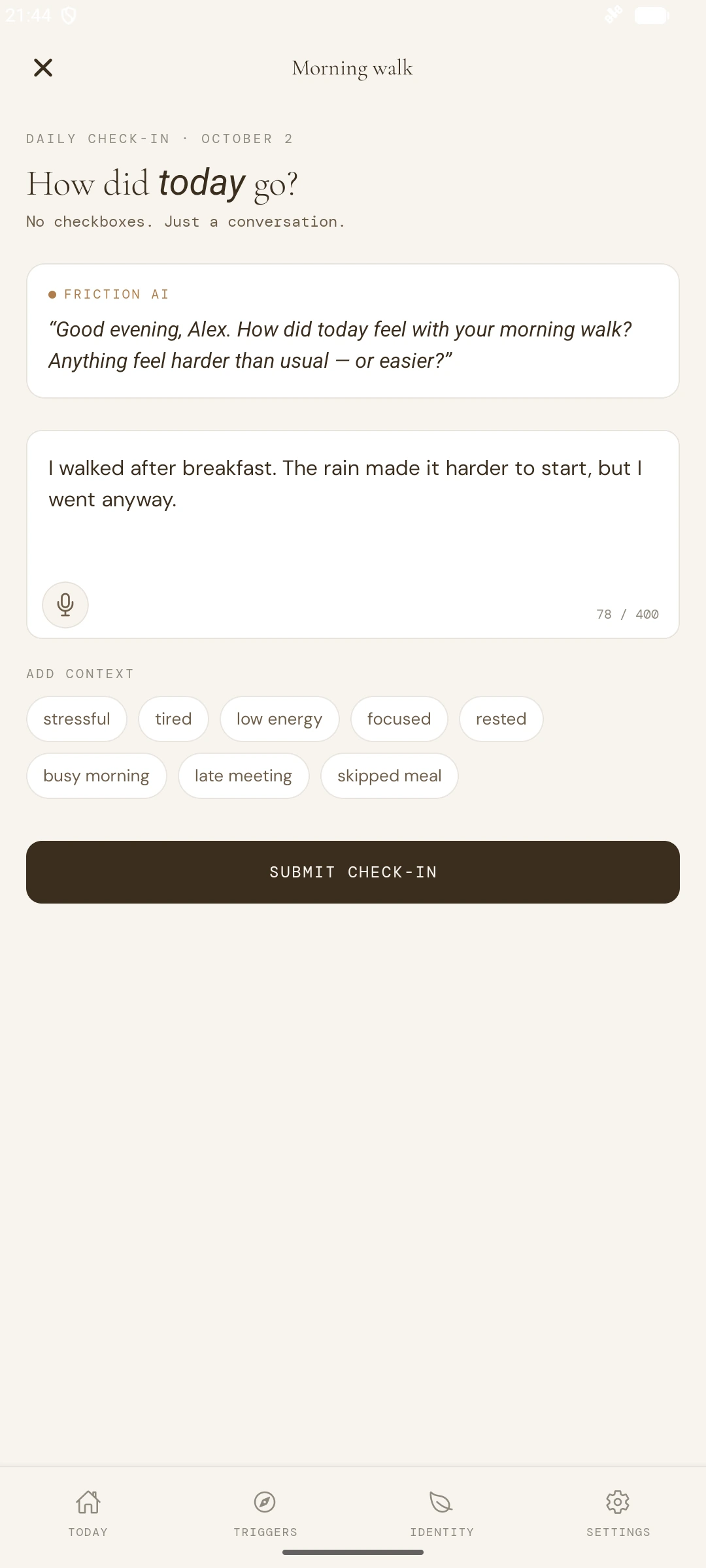
Check-ins start in the user's own words.
Tare check-in screen with a synthetic morning walk reflection.

Product intent

Make reflection useful as a durable record.

The flow gives people room to describe the day while retaining consistent check-in fields for the diary, recent momentum, and later insights.

  • Set up a build or break habit around an identity statement
  • Write a reflection or speak an entry and review its transcription
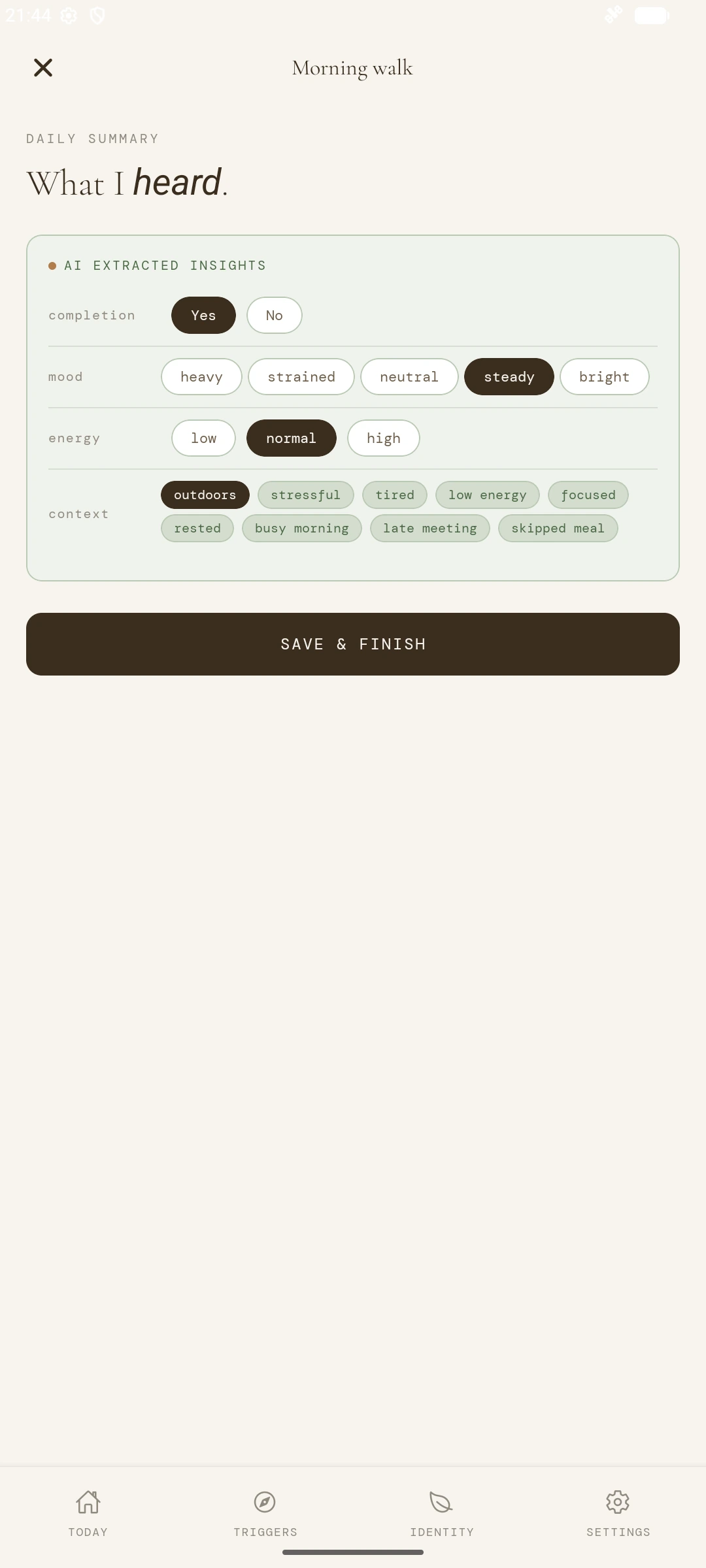
  • Review extracted fields and correct completion before saving
  • See recent completed-day momentum and recorded history

02 / AI and human control

The interpretation
stays reviewable.

Tare separates a person's original reflection from the structured information proposed by AI.

Someone might complete a goal despite a difficult day. They might avoid an unwanted behavior, feel proud of a small change, or notice a recurring obstacle.

Tare review screen with completion, mood, energy, and context fields.
Structured fields are proposed for review before saving.
Discuss an AI feature

Across the product

My Engineering Contribution

I developed the React Native application and Supabase backend, including onboarding and habit setup, written and transcribed check-ins, original-entry storage, structured AI extraction, review and correction flows, diary and progress views, scheduled analysis and notification paths, Free/Pro data and entitlement rules, and mobile build configuration.

The implementation spans the interface, backend state, data rules, and supporting service integrations.

Explicit boundaries

Free-form input needs explicit data boundaries.

One reflection is submitted at a time. Model output is a proposal rather than the authoritative user record, and extraction can fail after the original entry is saved.

  • An anonymous first-run still requires a successful Supabase Auth session
  • Completion means an action was done for a build habit or avoided for a break habit
  • Generated insights depend on enough saved history and configured services
  • Non-Android release and external service delivery require separate verification

User and system workflow

The Approach: Save First. Interpret Second. Let the User Review.

Tare separates a person's original reflection from the structured information proposed by AI.

  1. 01. Reflect Naturally

    A user writes a check-in or speaks an entry and reviews the transcription. Type freely or speak an entry and review its transcription in the same editable field.

    Editable input
  2. 02. Save the Original

    The reflection is stored before AI processing begins. Save the user's words before requesting analysis so they remain available if extraction fails.

    Durable original
  3. 03. Propose Structured Fields

    The AI workflow attempts to extract completion and contextual information in an expected format. Propose schema-checked completion and context fields; a successful result is not guaranteed.

    Proposed fields
  4. 04. Review the Interpretation

    The user can inspect the proposed information and correct the completion result before finalizing. Review the proposal and correct the completion value before finalizing.

    Completion correction
  5. 05. Build a History

    Saved records support diary views, recent momentum, and history-dependent insight paths. This makes the original reflection a lasting part of the record, rather than temporary input to a model.

    Reviewed record

Architecture

System boundary

Mobile app, durable data, and service paths

This is the implemented architecture, not proof that each external integration is operating in production.

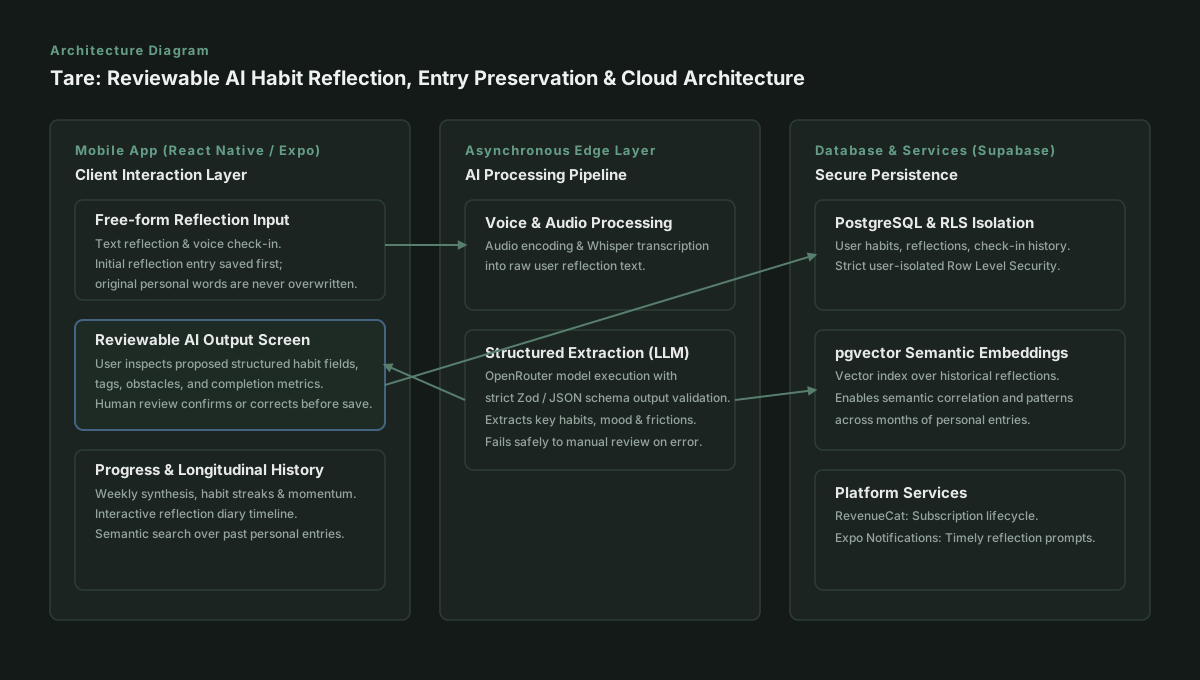
Tare architecture diagram showing original entry preservation, asynchronous edge LLM processing, review screen, and Supabase pgvector semantic search.
  1. React Native and Expo

    Identity-oriented onboarding, habit setup, check-in review, diary, and insight views.

  2. Supabase Auth and PostgreSQL

    Anonymous first-run sessions, habit and check-in records, row-level security, and tier rules.

  3. Edge Functions and AI services

    Structured extraction, voice transcription, summaries, and external integration paths.

  4. Scheduled PostgreSQL work

    Report and notification paths based on stored history and habit timing.

Engineering challenges

Where product judgment mattered

From reflection to a reviewable record

Challenge

Free-form check-ins vary, but progress views need consistent fields.

Why it mattered

A model interpretation should not silently replace what the person actually wrote.

Approach

Save the original entry, request schema-checked extraction, and show the proposed fields for review.

Trade-off

Review adds a step and extraction may fail.

Result

The original diary entry remains available even when structured analysis fails.
Make completion and limits explicit

Challenge

Build and break habits give the same completion field different meanings.

Why it mattered

The app also needs an enforceable active-habit limit across Free and Pro tiers.

Approach

Treat completion as doing a build action or avoiding a break action, and enforce active-habit limits in PostgreSQL.

Trade-off

The onboarding UI can stage more habits than the current Free database rule permits.

Result

The database remains the enforcement point; the onboarding inconsistency still needs product work.

Use history without overstating inference

Challenge

A single check-in cannot establish a recurring context pattern.

Why it mattered

Reports, correlations, and nudges need saved history and configured backend paths.

Approach

Derive rolling momentum from completed days and provide conditional paths for context observations, weekly reflections, friction reports, and cross-habit correlations.

Trade-off

Correlations and rule-based nudge scores do not prove causation, prediction accuracy, or behavior change.

Result

The implemented views describe recorded patterns when enough history is available.

Important decisions

The trade-offs behind the workflow

Preserve the Original Reflection

Decision

AI extraction may fail or misunderstand the user's meaning. By saving the original entry first, Tare keeps the person's words available even when structured analysis is incomplete.

Why

The user's words should survive an extraction failure or an incorrect interpretation.

Alternative considered

Let the model response become the final check-in immediately.

Trade-off

The user reviews completion before the structured update.

Why acceptable

The diary retains the original entry and the app can offer retry or Finish Later.

Make Interpretation Reviewable

Decision

AI-proposed fields are not automatically treated as the user's final record. The workflow allows completion to be corrected before the structured check-in is finalized.

Why

A model interpretation should not silently replace what the person actually wrote.

Alternative considered

Automatically commit the AI's classified completion and mood directly to progress metrics.

Trade-off

Adds a confirmation step to the check-in flow.

Why acceptable

Prevents misclassifications from corrupting historical momentum or recorded progress.

Base Progress on Saved Records

Decision

Recent momentum is calculated from recorded completion history rather than generated narrative alone. Other insight paths depend on the amount of available history and the required configured services. The presence of an observed pattern does not establish why it occurred.

Why

Progress views should use recorded completion state rather than generated narrative alone.

Alternative considered

Use model-generated summaries as the primary progress measure.

Trade-off

Momentum describes recent history without explaining its cause.

Why acceptable

The measure remains inspectable alongside diary entries and conditional insight reports.

03 / Behind the interface

Separate the mobile flow, records, and services.

The Expo app handles onboarding and review. Supabase Auth and PostgreSQL with row-level security hold profiles, habits, and check-ins. Edge Functions coordinate extraction, transcription, summaries, and external integrations; scheduled PostgreSQL work supports reports and notification paths.

The app includes a Free/Pro entitlement model. RevenueCat and Expo notifications are part of the integration architecture; their production operation is not established by repository code alone.

When extraction fails

When AI Doesn't Produce a Useful Result

An AI workflow needs a sensible failure path. In Tare, the original reflection remains saved if extraction fails. The interface provides options to retry or finish later rather than treating the entire check-in as lost.

This reflects a broader engineering principle: the product should remain understandable and recoverable when AI is imperfect. Tare writes the user's words before requesting model extraction. If analysis fails, the original entry remains and the UI offers retry or Finish Later; a structured result is not guaranteed. Typed output validation, row-level security, database habit limits, and report uniqueness support the implemented flow.

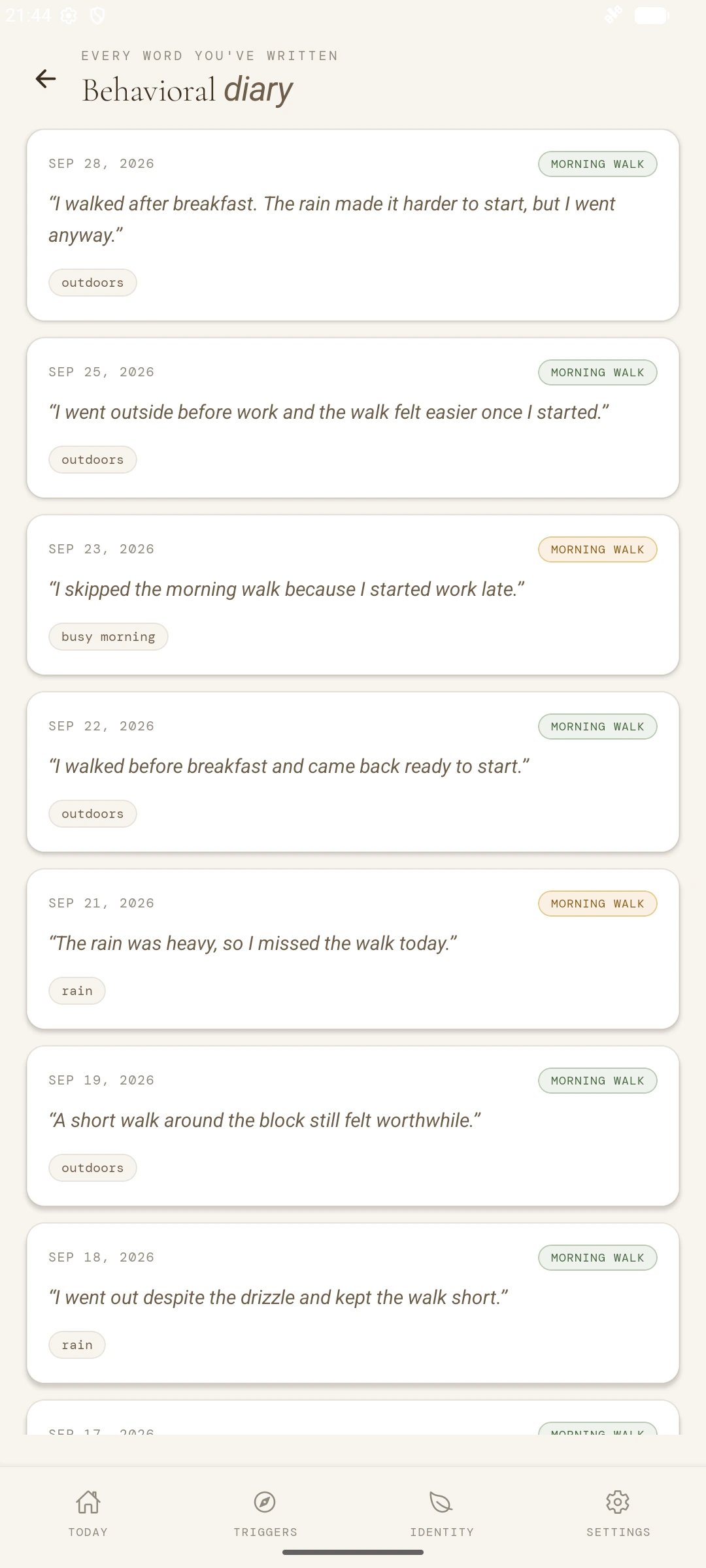
The original entries remain available in the diary.
Tare diary listing synthetic habit check-ins.
Weekly reports draw from saved check-ins.
Tare weekly report with synthetic narrative and next-week focus.

Implementation and availability

Implementation Status

Tare includes iOS and Android application architecture, check-in workflows, data storage, AI extraction paths, and supporting backend components.

The case study documents implemented engineering behavior. Tare is listed on Google Play for Android. Tare has iOS and Android app architecture; an iOS release, device/account/region installation eligibility, and external service delivery remain unverified.

History and interpretation

A growing history supports progress and observed patterns.

Saved check-ins support a diary and rolling momentum. Context observations, weekly reflections, friction reports, and cross-habit correlations are implemented paths in code; their runtime availability depends on saved history, configured services, and account state.

A correlation does not establish causation. Generating insights depends on enough saved history and configured services.

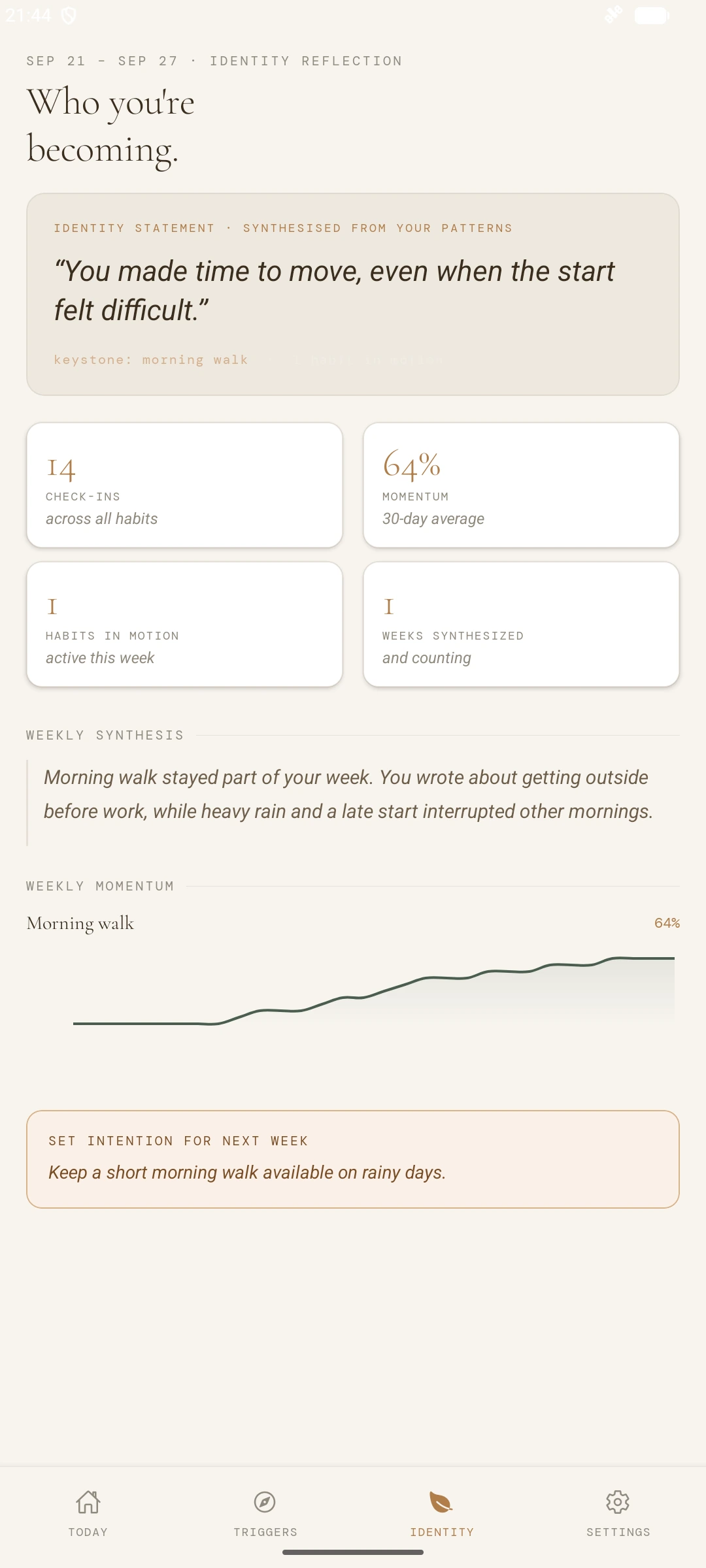
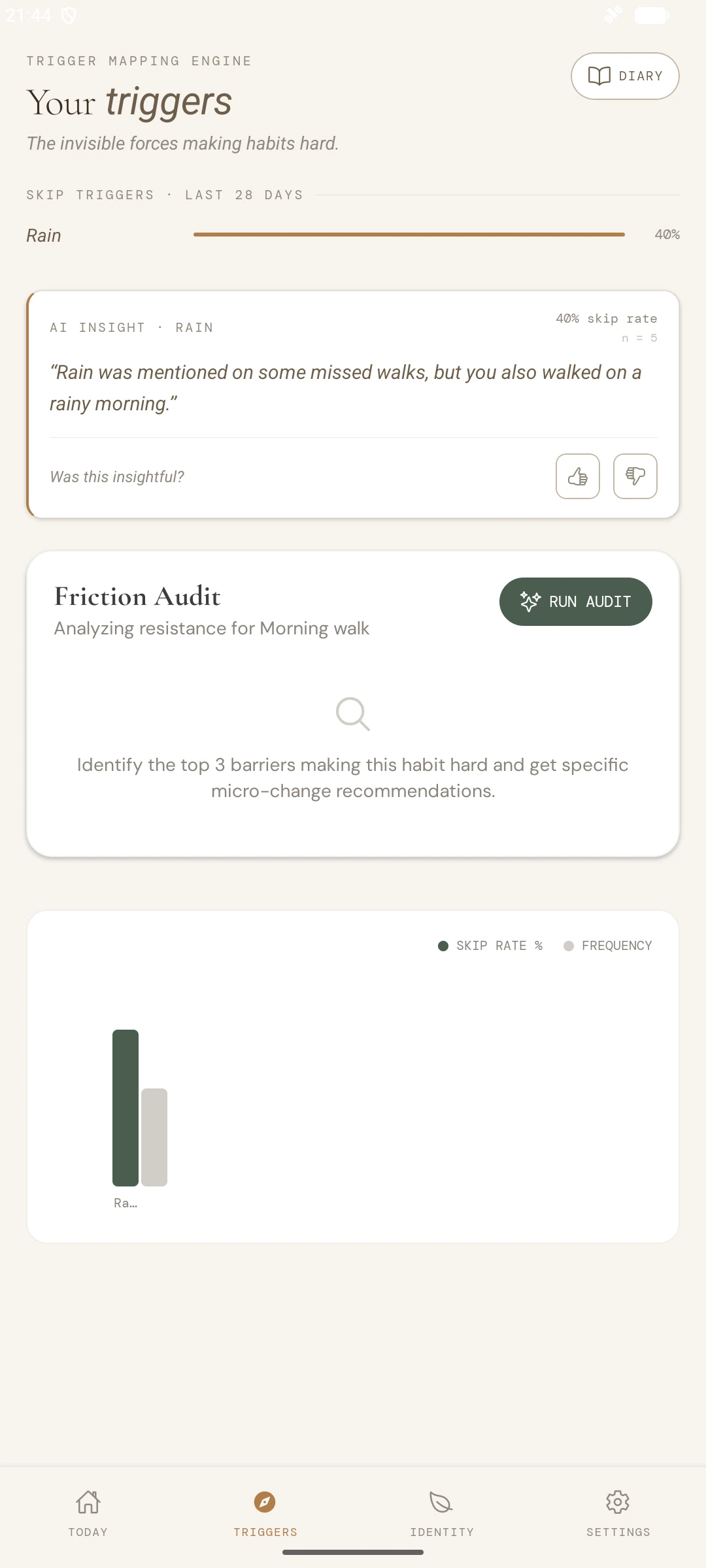
Tare insights screen with a synthetic context observation.
Saved context can be surfaced as an observed pattern.

Generated insights depend on enough saved history and configured services.

Product engineering

What Tare Demonstrates

Tare illustrates how conversational or natural-language input can fit into a product without losing data integrity and user control.

The key is to keep the boundaries clear: A user's original entry remains their record. AI offers an interpretation. The application validates and structures information for later use.

What carries forward

A check-in should remain inspectable.

Saving the original entry and reviewing proposed fields allows flexible input without treating an AI interpretation as unquestioned truth. Later views can draw from that saved history without becoming a separate chat memory.

Two Tare app screens showing a habit overview and a reviewed check-in.

Next / Mobile product engineering

SettleTab

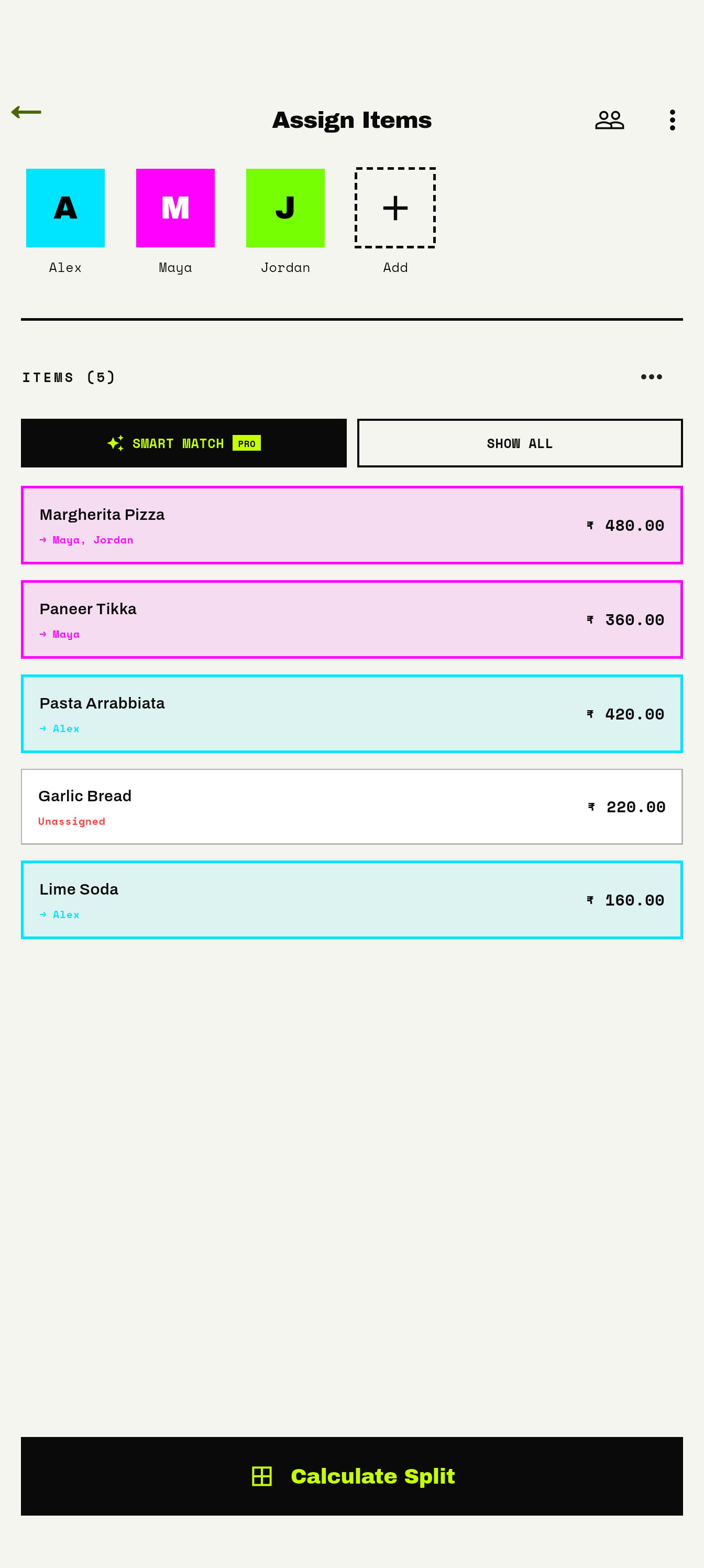
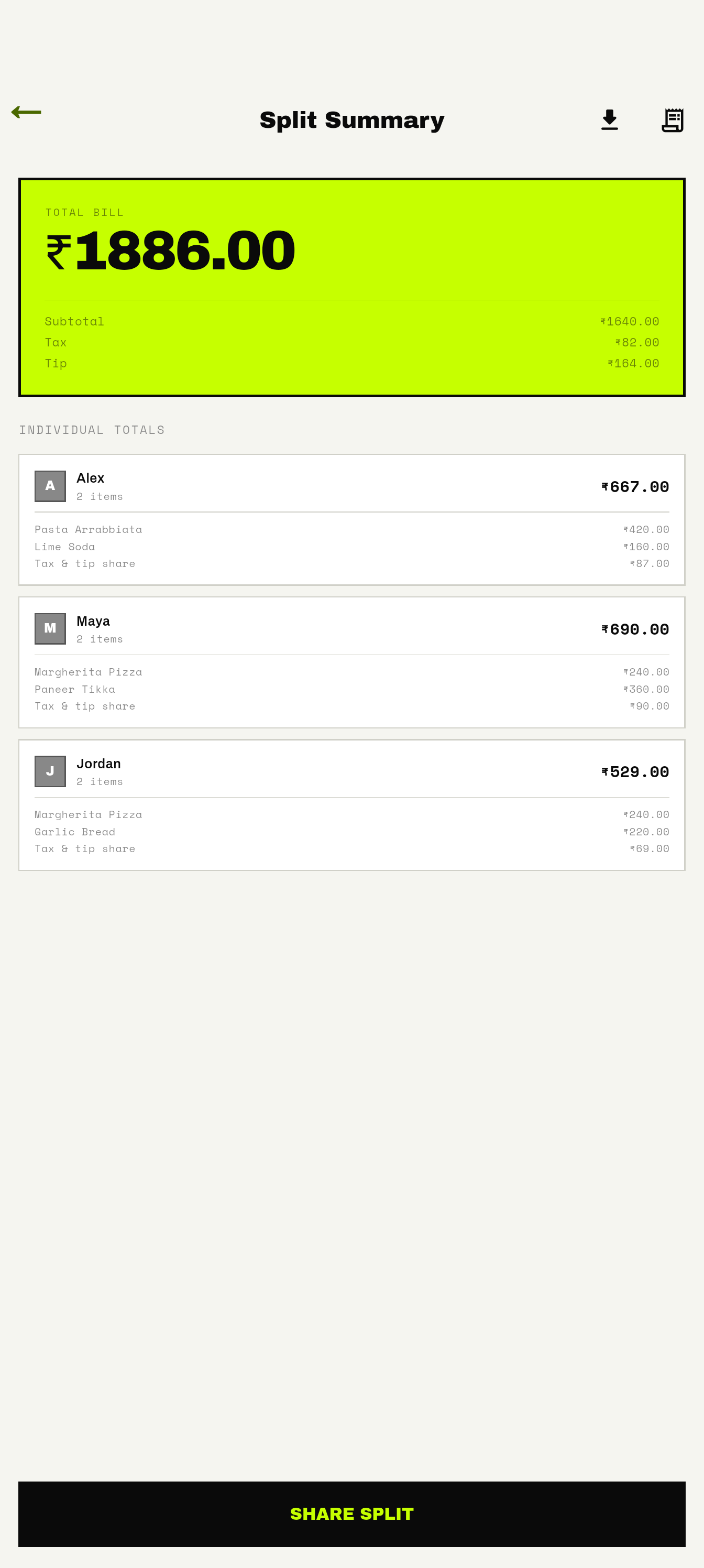
SettleTab is a live Android app for itemized shared bills. People can scan a receipt or enter items manually, correct the bill, assign individual and shared purchases, calculate what each person owes, and share a read-only result.

Explore SettleTab

Building a product with similar technical complexity?

Share the product problem, the current system, and where delivery is stuck.